
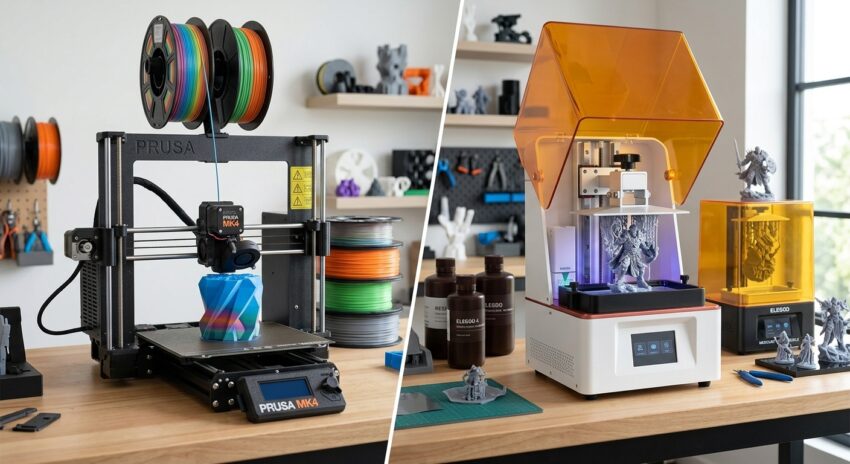
Entering the world of 3D printing is an exciting step, but it immediately presents you with a critical crossroads: Should you buy an FDM printer or a Resin printer?
While both technologies create physical objects layer by layer, they operate on completely different physical principles, require different working environments, and excel at entirely different applications. Choosing the wrong type for your goals can lead to frustration, wasted money, or an unused machine sitting on a shelf.
This guide breaks down every critical factor—from startup costs and spatial requirements to safety protocols and material durability—to help you make the right choice for your first 3D printer.
1. Core Mechanics: How They Work
Understanding how each technology builds an object is key to recognizing their strengths and limitations.
- FDM (Fused Deposition Modeling): Uses solid plastic filament supplied on a spool. The filament is pushed through a heated nozzle, melted, and extruded onto a build platform in precise tracks. The printer moves line by line, layer by layer, building the model from the ground up.
- Resin (SLA/MSLA – Stereolithography / Masked Stereolithography): Uses liquid photopolymer resin stored in a vat. An ultraviolet (UV) light source (usually an LCD screen masked by pixels) shines up through the transparent bottom of the vat, curing and hardening the liquid resin into solid plastic layer by layer as the print bed slowly lifts upward.
2. Direct Feature Comparison
| Feature / Metric | FDM (Filament) | Resin (SLA / MSLA) |
| Primary Material | Plastic Spools (PLA, PETG, ABS, TPU) | Liquid Photopolymer Bottles |
| Typical Layer Height | 0.12 mm – 0.28 mm | 0.01 mm – 0.05 mm |
| Surface Finish | Visible layer lines, textured | Ultra-smooth, injection-molded look |
| Feature Detail | Moderate (limited by nozzle diameter) | Exceptional (microscopic detail) |
| Part Durability | High impact & structural strength | Generally brittle (special resins required) |
| Build Volume | Medium to Very Large 220 mm – 500 mm + | Small to Medium 150 mm – 250 mm |
| Post-Processing | Minimal (remove supports and go) | Extensive (washing in IPA, UV curing) |
| Safety Equipment | Basic (heat hazard precautions) | High (gloves, respirators, ventilation) |
| Workspace Requirement | Desk / Office / Workshop | Well-ventilated dedicated area / Workshop |
3. Print Quality, Resolution, and Detail
The visual quality of a finished print is often the main reason makers lean toward one technology over the other.
FDM Quality
FDM resolution is primarily constrained by the diameter of the hotend nozzle (typically 0.4 mm). While FDM can produce clean, aesthetically pleasing models, layer lines are almost always visible to the naked eye. Curved surfaces on top of models can exhibit a “stair-stepping” effect. Achieving a smooth finish requires manual labor: sanding, priming, and filling.
Resin Quality
Resin printing shines when it comes to visual perfection. With layer heights as fine as 0.01 mm and XY resolutions defined by high-density 8K or 12K LCD screens, resin printers render layer lines virtually invisible. Complex textures—such as facial features, fabric folds, skin pores, and sharp armor edges—print crisp and clean.
Verdict for Detail: If you are printing tabletop miniatures (D&D, Warhammer), jewelry molds, or detailed scale models, Resin is the clear winner.
4. Mechanical Strength and Material Versatility
What good is a print if it breaks when you use it? The mechanical properties of your printed parts dictate what you can actually do with them.
FDM Materials
FDM offers an extraordinary range of real-world thermoplastics:
- PLA: Easy to print, rigid, great for general prototypes and decorative items.
- PETG: Tough, chemical-resistant, water-resistant, and flexible enough to absorb impacts.
- ABS / ASA: UV-resistant, highly durable, ideal for outdoor use and automotive parts.
- TPU: Fully flexible, rubber-like material for gaskets, tires, and protective cases.
- Composite Filaments: Carbon fiber or wood-infused filaments for enhanced stiffness or unique aesthetics.
FDM parts are structurally sound and excel at bearing loads, holding screws, and taking physical abuse.
Resin Materials
Standard resins produce rigid but brittle parts. If dropped onto a hard floor, a standard resin print will often snap or shatter.
- Standard Resin: Best for display-only figures.
- Tough / ABS-Like Resins: Offers higher impact resistance and slight flex to prevent shattering.
- Engineering Resins: High-temperature, rubber-like (flexible), or castable resins (which burn out cleanly for metal investment casting).
Engineering resins can narrow the strength gap with FDM, but they are significantly more expensive.
Verdict for Strength: For functional tools, mechanical brackets, household fixes, or outdoor equipment, FDM is vastly superior.
5. Ease of Use, Safety, and Workspace Setup
This is where many beginners get caught off-guard. The actual “printing” is only part of the experience.
FDM Workflow & Safety
- Workflow: Slice model ➔ Send file to printer ➔ Print ➔ Pull off bed ➔ Remove support structures ➔ Part is ready.
- Safety & Environment: FDM printing is clean and relatively odorless when using PLA or PETG. It can safely operate on a desk in a home office or bedroom (though enclosed printers are recommended for ABS/ASA due to fumes). Basic precautions involve avoiding the hot nozzle (200C – 260C) and heated bed.
Resin Workflow & Safety
- Workflow: Slice model ➔ Pour liquid resin into vat ➔ Print ➔ Remove part (wearing gloves) ➔ Wash part in Isopropyl Alcohol (IPA) to remove uncured resin ➔ Snip supports ➔ Secondary UV Curing under a lamp or cure station ➔ Dispose of contaminated wash liquids safely.
- Safety & Environment: Uncured resin is a toxic chemical irritant. Contact with skin can cause chemical burns or long-term allergies. Uncured resin and IPA emit strong Volatile Organic Compounds (VOCs).
- Required Gear: Nitrile gloves, safety goggles, organic vapor mask/respirator, dedicated wash/cure stations, and a room with active ventilation or an extraction fan.
Verdict for Usability: FDM is significantly cleaner, safer, and easier to manage in a standard living space.
6. Financial Investment: Initial vs. Ongoing Costs
While the entry price of hardware for both technologies has dropped dramatically, operational costs differ.
Initial Costs
- Entry-Level FDM Printer: $180 – $300 (e.g., Bambu Lab A1 Mini, Creality Ender series).
- Entry-Level Resin Printer: $150 – $250 (e.g., Elegoo Mars series, Anycubic Photon series).
Essential Accessories & Consumables
- FDM Needs: Filament spools $15 – $25. Optional: extra nozzles, spare build plates.
- Resin Needs: Resin bottles approx $20 – $45, Isopropyl Alcohol or dedicated solvent (approx $30), Wash & Cure Station $80 – $130), Nitrile gloves, replacement FEP/PFA vat films, paper filters, and safety masks.
Verdict for Cost: While the printer hardware costs are comparable, Resin printing carries higher recurring costs for safety gear, post-processing solvents, and replacement vats.
7. Build Volume and Print Speed
Size Matters
If you want to print large objects—like a full-sized wearable Mandalorian helmet, a large planter, or a storage box—FDM is the practical choice.
- FDM: Standard bed sizes start around 220 x 220 x 250 mm, with large-format options expanding up to 350 mm or 500 mm.
- Resin: Desktop resin build volumes are generally smaller (often around 140 x 89 x 165 mm for compact units, and up to 218 x 123 x 250 mm for medium-large units) due to the constraints of light dispersion across LCD panels.
Speed Dynamics
- FDM Speed: The print head must physically trace every line of every layer. Larger or more complex parts take exponentially longer.
- Resin (MSLA) Speed: The printer cures an entire layer all at once, regardless of how many objects are on the build plate. Printing 1 miniature takes the exact same amount of time as printing 15 miniatures of the same height.
Summary Decision Guide: Which One Should You Buy?
Buy an FDM Printer First If:
- You want to print functional parts, household fixes, mechanical gears, brackets, or cosplay items.
- You plan to keep the printer in a bedroom, office, or living room.
- You want a plug-and-play workflow with minimal cleanup and no hazardous liquid handling.
- You want to print large-scale objects affordably.
Buy a Resin Printer First If:
- Your main goal is printing tabletop miniatures, highly detailed figurines, or jewelry models.
- You demand an injection-mold smooth surface right off the print bed.
- You have a dedicated, well-ventilated workshop, garage, or shed to set up a safe chemical station.
- You don’t mind spending extra time on post-processing (washing, curing, and cleaning).
Final Thoughts
For most beginners, an FDM printer is the safest and most versatile entry point into 3D printing. It introduces you to 3D slicing software, bed leveling, and spatial design without the added complexity of toxic chemical handling. However, if your heart is set on painting hyper-detailed miniatures, nothing replaces the crisp precision of a resin printer.