
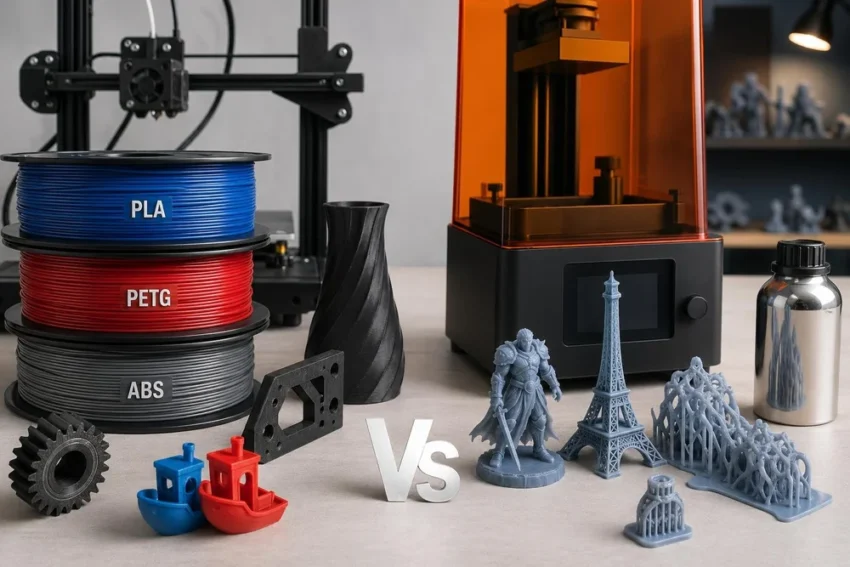
3D printing—also known as additive manufacturing—has transformed from an industrial prototyping tool into an accessible, household technology. Whether you want to print functional replacement parts, intricate miniatures, or custom engineering prototypes, understanding the fundamentals is your very first step.
In this guide, we will break down what 3D printing actually is, how the process works from start to finish, and explore the most popular 3D printing technologies available today.
How Does 3D Printing Work?
Unlike traditional subtractive manufacturing (like CNC milling or carving, which cuts away material from a solid block), 3D printing builds objects layer by layer from the ground up.
Every 3D print follows a simple four-step workflow:
- 3D Model Creation or Download: You start with a digital 3D model created in CAD software (like Fusion 360, Tinkercad, or Blender) or downloaded from model repositories (like Printables or Thingiverse).
- Slicing: The digital 3D model (usually an STL or 3MF file) is loaded into a “slicer” program (such as PrusaSlicer, Cura, or Bambu Studio). The slicer cuts the model into hundreds or thousands of horizontal layers and generates G-code—the instructions the printer follows.
- Printing: The printer reads the G-code and builds the object layer by layer on the print bed.
- Post-Processing: Once finished, the part may require support removal, sanding, curing, or painting depending on the technology used.
The Main Types of 3D Printers Available Today
While there are many industrial 3D printing technologies (such as SLS for nylon powder or DMLS for metal), two main categories dominate the desktop and consumer market: FDM and Resin (SLA/MSLA).
1. FDM / FFF (Fused Deposition Modeling)
FDM is the most widely used and recognizable type of 3D printer. It works by melting a solid plastic spool (filament) through a heated nozzle and extruding it layer by layer onto a build platform.
- Best For: Functional parts, mechanical components, household tools, large structures, and everyday prototypes.
- Common Materials: PLA (easy to print), PETG (durable and heat-resistant), ABS/ASA (strong outdoor plastics), and TPU (flexible rubber-like material).
- Pros: Clean and easy setup, wide variety of low-cost materials, large build volumes, robust parts.
- Cons: Visible layer lines, less precision on ultra-small details compared to resin.
2. Resin Printers: SLA & MSLA (Stereolithography)
Resin printers use liquid photo-polymer resin that cures and solidifies when exposed to ultraviolet (UV) light. Instead of an extruder moving around, an LCD screen or laser projects UV light from below a transparent vat of resin, curing one entire layer at a time.
- Best For: High-detail miniatures, tabletop gaming figures, jewelry designs, dental molds, and intricate artistic models.
- Pros: Incredibly high detail, virtually invisible layer lines, smooth surface finish.
- Cons: Messier workflow requiring chemical post-processing (isopropyl alcohol washing and UV curing), resin fumes require good ventilation, materials are more brittle.
What are the Most Popular 3D Printer Styles Right Now?
If you are looking at the market today, you will encounter a few specific printer architectures that dominate discussions:
CoreXY Motion Printers
CoreXY printers use a stationary motor arrangement with a complex belt system to move the print head rapidly along the X and Y axes, while the print bed only moves up and down on the Z axis.
- Why they are popular: They allow for extreme printing speeds without sacrificing quality or introducing vibrations. Enclosed CoreXY printers (like the Bambu Lab P1S/X1C or Voron builds) are currently the gold standard for high-performance desktop printing.
Open-Frame “Bed Slingers” (Cartesian i3 style)
The classic design where the print head moves along the X and Z axes while the entire build bed moves back and forth on the Y axis.
- Why they are popular: Extremely affordable, easy to repair, modify, and troubleshoot (e.g., Ender 3 series, Prusa MK4).
Which Printer Type Should You Choose?
- Choose FDM if: You want a clean desktop setup, plan to print durable functional items, or want to print large objects without dealing with liquid resin chemicals.
- Choose Resin if: Your primary focus is painting miniatures, detailed figurines, or high-precision small scale models where surface finish is critical.